an exercise of mapping Swedish research and development activities related to quantum sensing
01
What is Pre-Innova
In late 2025, as the Swedish innovation ecosystem began to align around what was arguably its most ambitious coordinated effort to date, a constellation formed to explore the creation of a cluster of excellence in quantum sensing.
At its core were world-class researchers based at the technical universities of Lund, Gothenburg, Linköping, and Stockholm, joined by representatives from relevant corporates and emerging start-ups. Alongside the scientific and industrial work, a dedicated work package was established to perform a landscaping exercise: to map Swedish research and development activities related to quantum sensing.
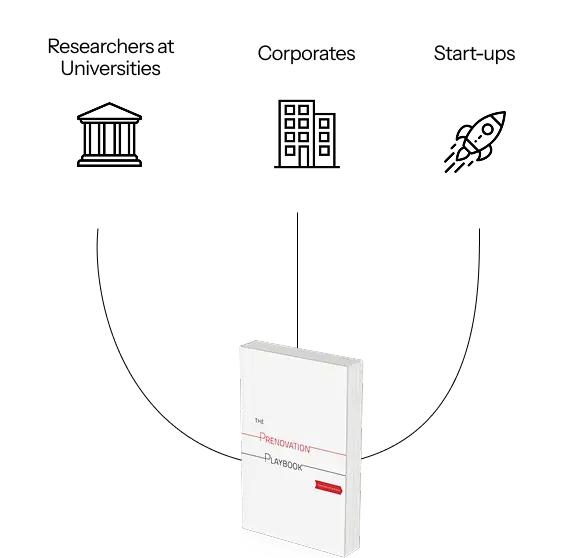
This task was taken on by a group that had previously conducted a similar exercise in the context of 2D materials. That earlier effort resulted in a playbook describing forms of scientific work that had not yet reached a stage where conventional innovation frameworks were applicable.
To name this intermediate state, the group coined the term prenovation: work that is too exploratory, too conceptually open, and too entangled with fundamental research to be meaningfully discussed in terms of products, markets, or deployment. Beyond the printed playbook—comprising more than 200 pages of interviews, analyses, and methodological reflections—the project also gave rise to a digital platform, prenovation.org.
Conceived as a shared workbench, the site allows material to be gathered, compared, and revisited over time, serving both as a public artefact and as an internal instrument for collective interpretation.
The quantum sensing landscaping effort builds directly on this experience. While the scientific domain differs, the underlying ambition is the same: to establish a sufficiently rich and nuanced picture of the current state of play to support informed discussion and decision-making at a later stage.
the ambition is to establish a sufficiently rich and nuanced picture of the current state of play to support informed discussion and decision-making at a later stage.
Relevant Topics
“a working label for a set of practices that make quantum systems measurable, controllable, and usable”
Framing Quantum Sensing
Quantum sensing is often presented as one of three foundational pillars of quantum technology, alongside quantum computing and quantum communication. While this tripartite framing has proven useful at a policy level, it obscures an important asymmetry.
From a technical and epistemic perspective, sensing, measurement, and quantum control constitute the enabling substrate upon which all other quantum technologies depend. The ability to prepare, stabilise, interrogate, and read out quantum states with high fidelity is not a specialised application in its own right, but a precondition for computation, communication, and simulation alike.
Seen from this angle, quantum sensing is less a sibling domain than a shared foundation. And precisely because it operates at this foundational level, it resists neat definition. Rather than forming a single, coherent field, quantum sensing cuts across disciplines, technologies, and levels of maturity.
For the purposes of this landscaping exercise, we therefore treat quantum sensing not as a sharply bounded category, but as a pragmatic one: a working label for a set of practices that make quantum systems measurable, controllable, and usable.
03
On landscaping
R&D landscaping is the practice of constructing a provisional, situated view of a research and development domain in order to support orientation, comparison, and judgement under uncertainty. It does not aim to resolve complexity or to offer a definitive account of a field, but to make emerging structures visible and discussable from a particular vantage point.
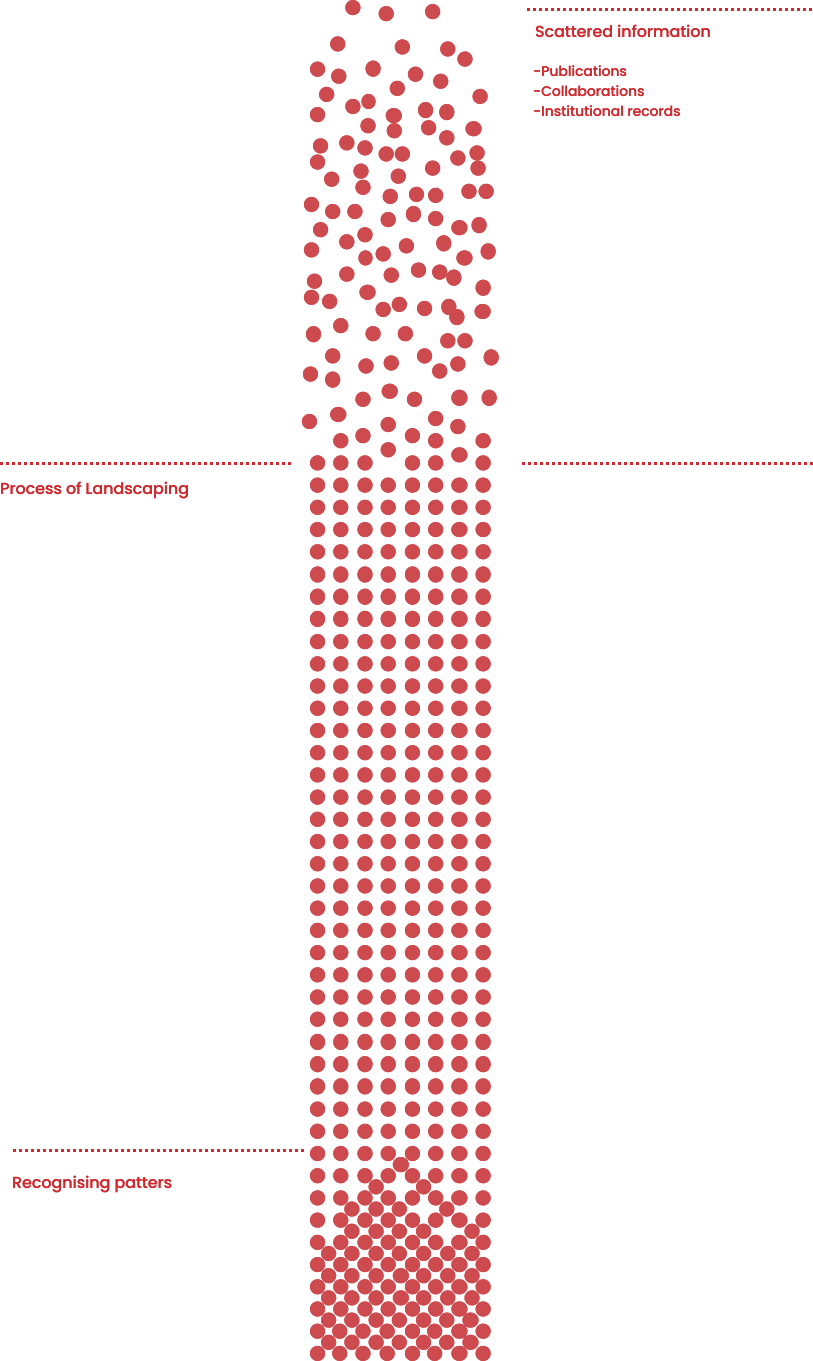
In this sense, landscaping places greater emphasis on the activity of mapping than on the production of a finished map. Much of the relevant information already exists—in publications, collaborations, and institutional records—but remains difficult to grasp in aggregate. Landscaping works by re-assembling this material so that patterns, concentrations, and absences can be perceived.
This emphasis on process shapes how the work is documented and shared. Rather than an accompanying website, the project maintains a public lab diary: a continuously updated working surface where the landscaping effort unfolds in real time.
It records how queries are refined, assumptions adjusted, and earlier framings revised as understanding develops. This work is led by KTH Innovation, in close collaboration with the university library, and draws on the expertise of the team behind LinkedScholar. From this vantage point, scientific publications are the most natural place to begin.
Bibliometrics provide a structured way of following research trajectories, collaborations, and emerging clusters, and therefore form the backbone of the initial exploration. The landscape presented at any given moment is therefore provisional: a snapshot taken from a specific position, intended to support orientation and discussion rather than to offer a final or exhaustive account.
04
Web of Science
9.000 publications
From bibliographics to bibliometrics
The landscaping exercise begins, deliberately, at the level of the scientific literature. Not because publications exhaust what matters in the development of quantum sensing, but because they offer a stable and inspectable trace of how the field currently articulates itself.
Bibliographics, in this sense, is less about measurement than about listening: asking what kinds of work are being named, grouped, and connected under the banner of quantum sensing, and by whom.
Our initial point of entry is the Web of Science. At this stage, the aim is not precision but coverage. Broad lexical queries are used to capture a wide family of measurement-related practices that draw on quantum concepts, techniques, or intuitions. The resulting corpus—on the order of nine thousand publications—inevitably contains noise, overlap, and internal tension. This is treated as a feature rather than a flaw, allowing adjacent and partially overlapping traditions to surface before stronger filtering is applied.
In parallel, a second entry point is pursued through an actor-based search seeded by the researchers participating in the consortium. Tracing their co-publication networks outward yields a corpus of comparable size and scope.
The convergence of these two approaches—one lexical, one relational—is analytically reassuring. Their differences, in turn, reveal where the field is shaped by shared language and where it is held together by collaborative practice.
At this stage, Web of Science functions primarily as a retrieval layer. Its disciplinary labels and journal-based classifications provide orientation, but are too coarse for the kind of nuanced analysis quantum sensing demands. To move beyond these limitations, the retrieved corpus is transferred into Bibmet, a custom bibliometric database developed at KTH.
This transition marks a shift from bibliographics to bibliometrics proper. Within Bibmet, publications can be deduplicated, enriched with citation indicators, and analysed at finer granularity. Topics are inferred from the textual content of the papers themselves rather than from publication venues, and researchers, institutions, and collaborations can be traced across time and context.
This move does not replace interpretation with automation. Bibliometrics, as used here, is a set of instruments that make certain structures more legible while leaving others in shadow. Queries are adjusted, thresholds revisited, and models iterated as understanding deepens. The resulting landscape is therefore not a final map, but a working surface: structured, inspectable, and open to revision as the work progresses.
Actor-based Search
Bibliometric Search
05
Going Sub-Symbolic
The bibliometric landscape assembled so far is, by design, symbolic. It is built from things that can be named and counted: words, authors, institutions, citations, topics. This makes it legible. We can point to a cluster, explain why it exists, and argue about its boundaries.
But research fields are not held together by language alone.
Much of what connects work in quantum sensing lives below the level of explicit description: shared experimental tricks, mathematical habits, intuitions about what constitutes a “good” problem, or tacit understandings of what is worth measuring at all.
These forms of proximity are often sensed by practitioners long before they are stabilised in terminology or disciplinary labels.
To access this less articulate layer of structure, the landscaping effort turns to sub-symbolic methods. These rely on computational models that learn patterns of similarity from data, rather than starting from predefined categories. Instead of asking how papers are labelled, they ask a simpler question: which papers look similar, when considered in their entirety?
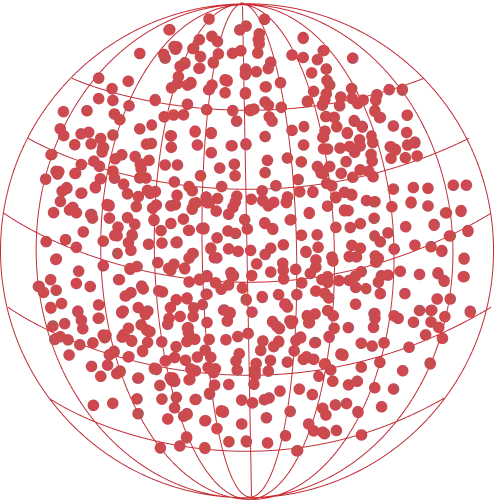
In practice, this involves representing publications as numerical objects—embeddings—that capture patterns of similarity across their full textual content. Once translated into this form, papers can be compared, grouped, and projected into lower-dimensional spaces where distances and neighbourhoods become visible. What emerges is not a classification, but a topology: a sense of which lines of work lie close together, which form dense regions, and which occupy more isolated positions.
Such representations make it possible to see continuities that cut across familiar boundaries, as well as fractures within seemingly coherent areas. They often surface relations that are difficult to articulate in words, but immediately recognisable once seen.
Sub-symbolic analysis does not replace the symbolic layer described earlier. It complements it. Where bibliometrics provides anchors and reference points, sub-symbolic views add texture and depth. Moving between the two allows the landscape to be explored from multiple angles, keeping it open to forms of structure that have not yet fully announced themselves.